

The Dawn of Caucasian Tribes
Delve into the rich heritage and profound origins of the Caucasian tribes
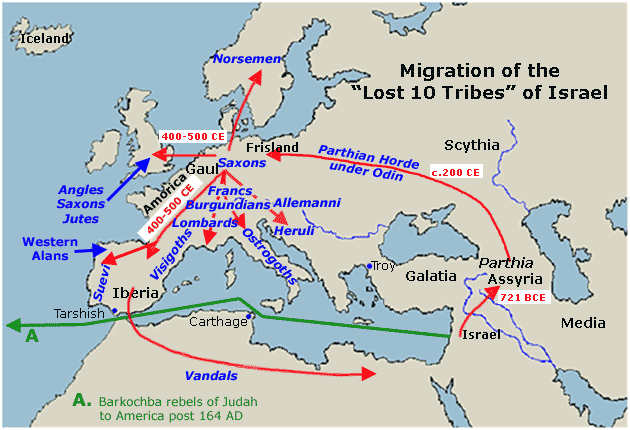
BIRTH OF THE CAUCASIAN TRIBES
The origin of the Caucasian Race is shrouded in antiquity, but this much is certain: the name itself indicates that many of these people migrated into Europe through the Caucasus Mountains of Eastern Europe, just north of Assyria and Palestine. Historians still debate whether these tribes originated in northern Europe and later traveled south to the Caucasus region, or conversely, originated down in Mesopotamia and migrated north through the Caucasus into Europe. The Encyclopedia Britannica, while professing no final opinion on this, makes the revealing admission, “It has been observed with truth that so many populous nations can hardly have sprung from the Scandinavian penninsula.”4 The same source also points out that these tribes spoke a language akin to ancient “Iranian” (i.e., an early Mesopotamian dialect. This was no accident, for the Israelites descended from Abraham who originated in Chaldea in Mesopotamia.) It would therefore seem obvious that these newly discovered peoples originated in Mesopotamia, at the same time and place that the Ten Tribes of Israel were “lost” and disappeared from history. God’s people disappeared under the name of Israel by the early 7th century B.C., and immediately reappeared in the same region under other names by which they played an important part in the early history of Asia Minor and eastern Europe.
Many history books show an area marked “Iberia” or “HEBREW’S LAND” in the Caucasus Mountains region between the Caspian and Black Seas, north of the Euphrates. The word, Hebrew, means a descendant of Eber, the great-grandson of Noah. Even to this day, Spain is known as the Iberian Peninsula, and Ireland by the slight variation, Hibernia, both indicating their Hebrew origins in antiquity.
In the apocryphal book of 2 Esdras 13, verse 40, we read: “These are the Ten Tribes, which were carried away prisoners out of their own land in the time of Osea the king, whom Salmanesar, the king of Assyria, led away captive, and he led them over the waters, and so came they into another land. But they took this counsel among themselves, that they would leave the multitude of the heathen, and go forth into a further country, where never mankind dwelt…And they entered into Euphrates by the narrow passages of the river…For through that country there was a great way to go, namely of a year and a half; and the same region is called Arsareth.” “Ar” is the Chaldean word for river, and Biblical archaeologist Dr. E. Raymond Capt believes it may refer to Eastern Europe, in the region of modern Romania, where the river Sareth still exists.
FULFILLED PROPHECY
The New Testament affirms that not only would Israel continue to exist as a people, but they would also be spiritually restored through belief in their Savior, the Son of God. The Apostle Paul, quoting the prophet Hosea says, “Yet the number of the children of Israel shall be like the sand of the sea, which cannot be measured nor numbered; and it shall come to pass that, in the place where it was said unto them, Ye are not my people, there it shall be said unto them, Ye are the sons of the living God.” (Hosea 1:10; Rom. 9:26) Where has this prophecy seen fulfillment? Who are these millions who are called numerous as the sand of the sea, are popularly told are “not God’s people Israel,” and yet are known as “Sons of the living God,” or Christians? That this is the proper interpretation of the prophecy may be seen in the evangelical publication, Pulpit Commentary, which maintains, “The place, then, where they should be called the sons of the living God is wheresoever they should believe in Christ.” (vol. 18, p. 270) Yes, Hoseh’s prophecy has been fulfilled today in the nations of Christendom, “Christ’s Kingdom,” where we are told that we are not God’s people, Israel, but that we are “the sons of the living God,” or Christians. It is therefore no coincidence that 95% of Bibles, gospel tracts, and missionary work go out from “Caucasian” Christian lands! We are the modern descendants of God’s servant people, fulfilling prophecy even as “blindness in part has happened to Israel.” (Romans 11:25).
The prophet Isaiah stated, “And the nations shall see thy righteousness, and all kings thy glory; and thou shalt be called by a new name, which the mouth of the Lord shall name.” What new name was prophesied for Israel? Hosea said it was “Sons of the Living God,” or Christians!
Historians record the arrival of millions of dispersed tribes, known to us today as Cimmerians, Angles, Saxons, Scythians, and similar names, who flooded into Europe from Asia Minor in the early pre-Christian centuries. They poured through the Caucasus Mountain region (whence the name, “Caucasian”) into southeastern Europe at the very same time and place as six million lost Israelites disappeared from history. Surely the disciples of Christ also knew this fact, for they not only went straight to Europe to spread the gospel, but James and Peter addressed their epistles to this same people, “the twelve tribes scattered abroad” to Europe. These are the prophesied Israel “company of nations” (Gen. 35:11), now “thousands of millions” strong, whose colonizing descendants long ago began to “possess the gate of those which hate them.” (Gen. 24:60) The prophetic marks are certain: the lost and scattered tribes of the diaspora have been found!
Some have sought to allegorize the twelve tribes to whom Peter and James wrote their epistles, as if the reference were meant to apply corporately to all Christians. But to the contrary, the Pulpit Commentary explains, “it appears to have been written, mainly at least, to Israelites of the dispersion.” (vol. 18, p. 269)
In 1723, the French church scholar and Huguenot refugee, Dr. Jacques Abbadie, wrote a book titled, “The Triumph of Providence” in which he stated, “Unless the ten tribes of Israel are flown into the air, or sunk into the earth, they must be those ten Gothic tribes that entered Europe in the fifth century, BC… and founded the ten nations of modern Europe.”
The Apostle Paul, in his letter to the Galatians on the border of Europe, stated, “They which are of faith, the same are the children of Abraham.” (Gal. 3:7) Yes, the nations of Christendom ARE the descendants of Abraham and the Israelites of the Bible! As Peter said to these “sojourners of the dispersion,” so we say to you, “Wherefore the rather, brethren, give diligence to make your calling and election sure; for if ye do these things, ye shall never fall.” (2Peter 1:10)